

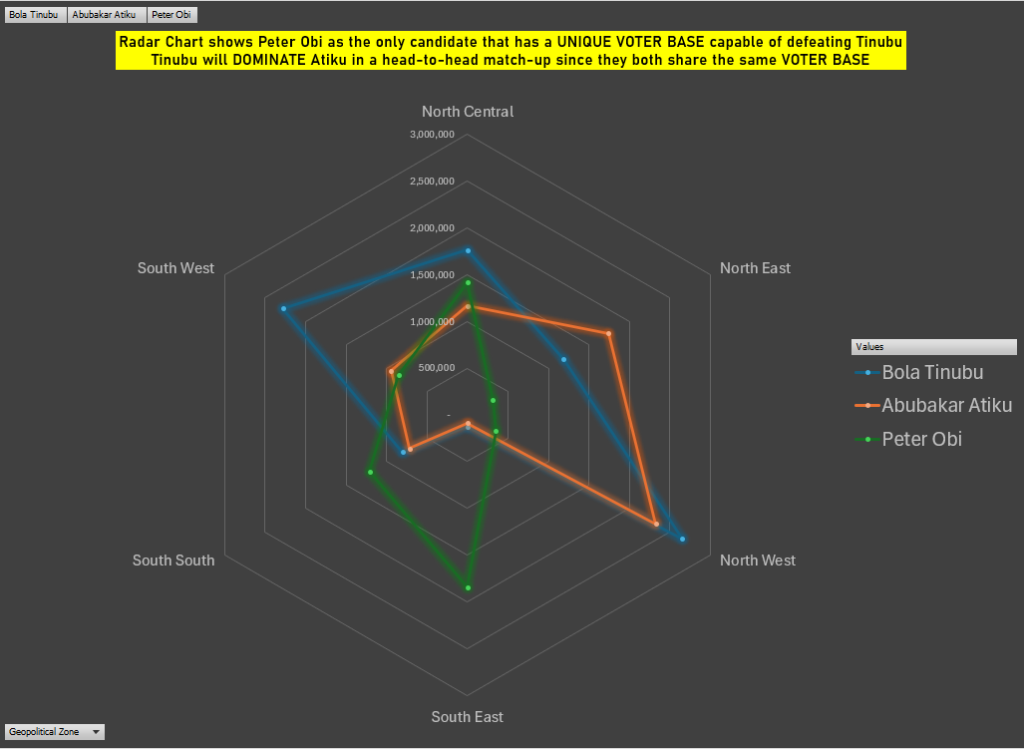
Nigeria’s 2023 presidential election didn’t just produce a winner; it revealed three distinct electoral coalitions with very different “geographies of strength.” When you aggregate the results by geopolitical zone (as visualized in the attached radar chart), a clear strategic conclusion emerges:
- Peter Obi’s coalition is structurally different from Tinubu’s and Atiku’s and can be expanded into a winning national plurality.
- Atiku and Tinubu draw heavily from overlapping pools, meaning a Tinubu–Atiku head-to-head is fundamentally tilted toward Tinubu’s better-anchored, more defensible map.
This isn’t a personality argument. It’s coalition mathematics.
What the 2023 Results Reveal: Three Coalitions, Three Geographies
The 2023 zone-level voting pattern produced a clean, interpretable structure:
1) Obi’s coalition: South East lock + South South lead
In 2023, Obi wasn’t merely competitive in the South East, he was dominant.
- South East: Obi 1,952,998 vs Tinubu 127,370 vs Atiku 90,968
Obi effectively owned the zone. - South South: Obi 1,210,675 vs Tinubu 799,957 vs Atiku 717,908
Obi led in a zone that historically swings, proving his coalition is not “single-region only.”
This is what strategists call a non-overlapping anchor: a base that the incumbent cannot easily “trade” with small tactical gains elsewhere.
2) Tinubu’s coalition: South West fortress + North West plurality
Tinubu’s 2023 strength was anchored by two massive vote engines:
- South West: Tinubu 2,279,407 (and a huge margin over rivals)
- North West: Tinubu 2,652,235 (plurality in the country’s largest vote zone)
Together, they create the kind of “structural advantage” incumbents love: high vote volume + strong political machinery + turnout capacity.
3) Atiku’s coalition: North East dominance, but limited travel
Atiku’s clearest home zone was:
- North East: Atiku 1,737,846 (dominant performance)
But outside the North East, the 2023 pattern shows Atiku competing in spaces where Tinubu is already strong or at least structurally competitive (North West, North Central), while having comparatively weak standing in zones that can offset Tinubu’s anchors (South East and much of South South).
The Strategic Difference: “Additive” vs “Overlapping” Voter Bases
Here’s the simplest professional way to interpret the radar chart:
Obi’s votes are additive against Tinubu
Obi’s biggest strengths sit where Tinubu is weakest (especially South East, and meaningfully South South). That means:
- Obi can begin the race with large margins already banked in zones Tinubu cannot easily neutralize.
- Every incremental gain Obi makes in contested zones (especially North Central) is more likely to be net-new against Tinubu’s coalition rather than just swapping votes within the same pool.
In coalition terms, Obi’s base is structurally different, it expands the opposition frontier instead of fighting the incumbent on the incumbent’s home turf.
Atiku’s votes are largely overlapping with Tinubu
Atiku’s path relies heavily on northern competition where Tinubu is also viable. That creates a problem in a two-horse race:
- Both candidates chase the same persuadable blocs.
- When coalitions overlap, advantages like incumbency, party machinery, and established networks become decisive.
- Tinubu’s South West fortress becomes an immovable weight Atiku must offset, yet Atiku lacks an equivalent fortress elsewhere.
That is what “shared voter base” looks like in real numbers: the contest becomes a fight over the same electorate, and the candidate with the stronger anchor and machine typically wins.
The 2027 Projection: Obi Has the Only Coherent “Non-SW Flip” Path to Victory
To defeat Tinubu, an opposition candidate has two theoretical routes:
Route A: Break Tinubu’s South West fortress
This is the hardest path in Nigerian electoral reality because it requires overcoming:
- deep political networks,
- turnout systems,
- incumbency influence,
- and regional loyalty structures.
No 2023 data suggests Atiku is positioned to do this. Obi doesn’t need to do it either.
Route B: Build an offset coalition Tinubu doesn’t already own
This is where Obi becomes uniquely viable.
Obi’s 2027 win condition, based on the 2023 map, is straightforward:
- Hold the South East at near-2023 dominance
- Retain and deepen South South competitiveness
- Convert North Central from “contested” into “lean-Obi”
- Reduce Tinubu’s margins in the South West and parts of the North West (not necessarily win them, just compress the gap)
Why North Central is the real battleground
North Central is the zone where the 2023 data signals real strategic leverage:
- Tinubu ≈ 38.6%
- Obi ≈ 31.0%
- Atiku ≈ 25.5%
That is not a locked zone. It’s the definition of a swing arena.
If Obi can lift his North Central share modestly, through credible security, cost-of-living, jobs, agriculture value-chain and anti-waste governance messaging, he changes the entire national arithmetic. And importantly, North Central is sociologically positioned to respond to “performance and governance” appeals in a way that is not fully captured by identity only politics.
In short: Obi’s path doesn’t require a miracle. It requires targeted expansion where the data shows elasticity.
Reality 1: Peter Obi’s Unique Voter Base—The Only Growth Vehicle
Peter Obi’s 2023 performance wasn’t just impressive, it was revolutionary. He achieved what political scientists considered impossible: breaking Nigeria’s entrenched religious-regional voting pattern.
The Obi Phenomenon:
- Dominant in Southeast: 93.2% vote share (1.84M/1.98M total)
- Competitive in South-South: 44.5% vote share (1.21M/2.73M)
- Unexpected Northern Inroads: 1.08M votes across three Northern zones
But here’s what makes Obi uniquely dangerous to Tinubu in 2027: His voter base doesn’t overlap significantly with Tinubu’s.
The Expansion Trajectory:
Obi can grow his support from 5.98M to 7.25M+ votes by:
- Consolidating Southeast: Natural growth to 1.95M (+6%)
- Expanding South-South: Strategic gains to 1.55M (+28%)
- Winning North Central: From 1.42M to 1.75M (+24%)
- Making Southwest Inroads: From 0.85M to 1.15M (+35%)
- Holding Northern Gains: Maintaining 0.85M across Northeast/Northwest
This growth comes from:
- Disillusioned PDP voters (not Tinubu’s base)
- 8-10 million new youth voters (2027 projections)
- Northern Christians seeking representation
- Urban professionals across all regions
Strategic Insight: Obi grows by creating NEW coalitions, not cannibalizing existing ones. Tinubu’s base—built on traditional structures, APC loyalty, and Northern Muslim consolidation—remains largely immune to Obi’s appeal. This means Obi can reach 7.25M+ votes WITHOUT significantly reducing Tinubu’s 8.80M base.
The Peter Obi Factor: The Power of the “Insulated” Voter
Strategic analysis of the 2023 radar distribution shows that Peter Obi’s support is not a “slice” of the existing pie; it is a new pie entirely. While the APC and PDP traditional bases are built on legacy patronage and regional governors, the Labor Party’s base is built on Demographic Identity and Urban Convergence.
The “Monopoly” Advantage
In the South-East and parts of the South-South, Obi achieved what political scientists call “Total Capture.” By securing over 80% of the valid votes in states like Anambra and Abia, he created a regional fortress that is functionally impenetrable to both Tinubu and Atiku.
Urban Penetration as a Tactical Edge
Unlike traditional candidates who rely on rural mobilization via local “gatekeepers,” Obi’s victory in Lagos and the FCT proved he has mastered the Urban-Youth Nexus. This is a “Unique Voter Base” because it is:
- Highly Mobile: They use digital tools for organic mobilization.
- Ideologically Driven: They are less susceptible to the “stomach infrastructure” (patronage) that powers the APC and PDP machines.
- Non-Overlapping: This base did not exist within the PDP or APC frameworks prior to 2022. It is a “Third Force” that remains loyal to the candidate, not the party structure.
Strategist’s Insight: For 2027, Obi does not need to convert Tinubu’s core supporters; he only needs to activate the 65% of registered voters who did not cast a ballot in 2023. His unique brand is the only one capable of inspiring this “sleeping giant” of the electorate.
The Tinubu-Atiku Deadlock: Two Horses, One Stable
When we analyze a potential head-to-head between Bola Tinubu and Atiku Abubakar, we see a Strategic Overlap. Both candidates draw from a similar pool of traditional voters, Northern power brokers, and legacy political structures.
The Cannibalization Effect
In a two-horse race, Atiku and Tinubu are effectively fighting for the same “Political Real Estate” in the North-West and North-East.
- The incumbency Factor: In a matchup where both candidates use similar tactics (machinery-led mobilization), the incumbent (Tinubu) holds the ultimate advantage. He controls the federal apparatus, the security architecture, and the loyalty of the majority of sitting governors.
- The Southern Erosion: Atiku’s path to the presidency historically relied on a North-South coalition. However, the rise of the Labor Party has permanently fractured the PDP’s southern base. Without the South-East and South-South, Atiku enters a 2027 matchup with Tinubu as a “Regional Candidate” fighting a “National Incumbent.”
| Competitive Metric | Tinubu (APC) | Atiku (PDP) | Strategic Edge |
| Machinery | High (Federal/State) | Moderate (Party) | Tinubu |
| Core Base | South-West | North-East | Tinubu (Larger Floor) |
| Youth Appeal | Low | Low | Neutral |
3. 2027 Projection: Consolidation vs. Cannibalization
The road to 2027 will be defined by one question: Can the opposition create a unique alternative, or will they fight over the same scraps?
If the PDP presents Atiku Abubakar again, they are engaging in a battle of Cannibalization. They will attempt to steal votes from Tinubu’s Northern base, a task made nearly impossible by the APC’s control of state resources.
However, Peter Obi’s path is one of Consolidation. By holding his “Unique Base” (The South and Urban Youth) and expanding into the North-Central “Middle Belt,” Obi creates a geographic and demographic pincer movement. He is the only candidate who brings “new money” (new voters) to the table, whereas Atiku and Tinubu are simply trading the same “currency.”
Why Tinubu Would Dominate Atiku in a Two-Horse Race
A two-horse race removes third-party distribution and forces coalition consolidation. In that environment, Tinubu holds the structural advantage over Atiku for three reasons:
1) Tinubu begins with a giant South West cushion
In 2023, Tinubu’s South West advantage over Atiku is not marginal—it’s massive. In a head-to-head, Tinubu can consolidate SW even further because it becomes a binary choice, and the party ecosystem pushes unity.
2) The North becomes a competition inside Tinubu’s comfort zone
Atiku’s main growth areas are largely in the North—exactly where Tinubu is already competitive and where APC’s infrastructure is deeply embedded. When two candidates chase the same persuadables, the incumbent coalition tends to harden, not fracture.
3) Atiku lacks an “unstealable” counter-fortress
Atiku has the North East, but it does not function as a complete offset to Tinubu’s SW + NW structure. Without a second locked zone (like Obi has with the South East), Atiku must win an exceptionally broad map to compensate for SW. That is difficult even before incumbency effects are considered.
Conclusion: In Tinubu vs Atiku, Tinubu’s coalition is more defensible, more scalable, and better anchored. That is what “Tinubu dominates Atiku” means in electoral terms: Tinubu wins by holding his fortress and remaining merely competitive elsewhere.
How Tinubu Annihilates Atiku in a Two-Horse Race
Now consider the alternate 2027 scenario: Tinubu versus Atiku. The outcome isn’t just predictable, it’s mathematically inevitable.
The Fatal Flaw: Shared Voter Base
Atiku and Tinubu are fishing in the same pond: Northern Muslim voters. In 2023:
- North West: They split 4.98M votes (Tinubu 53%, Atiku 47%)
- North East: They split 2.93M votes (Tinubu 41%, Atiku 59%)
- North Central Muslim areas: Approximately 50/50 split
In a head-to-head contest, this shared base becomes Atiku’s coffin.
The Incumbency Multiplier
As sitting president, Tinubu gains:
- Patronage Power: Federal appointments, projects, resources
- Financial Dominance: 3:1 spending advantage
- Structural Control: 17 of 19 Northern states under APC governors
- Traditional Alignment: Emirates and religious establishment support
Projected 2027 Head-to-Head Outcome:
Base Retention:
- Tinubu keeps 7.50M of his 8.80M base (85% retention)
- Atiku keeps 5.60M of his 6.98M base (80% retention)
Obi’s 2023 Voters Split:
- 2.10M to Tinubu (35%)—Northern Christians preferring ANY Northern Muslim to Atiku
- 1.80M to Atiku (30%)—Traditional PDP loyalists
- 2.08M abstain (35%)—Protest against both options
New Voters (8M projected):
- 3.20M to Tinubu (40%)—Incumbency advantage
- 2.40M to Atiku (30%)—Opposition sentiment
- 2.40M abstain (30%)—Disillusioned youth
FINAL TALLY:
- Tinubu: 7.50M + 2.10M + 3.20M = 12.80M votes
- Atiku: 5.60M + 1.80M + 2.40M = 9.80M votes
Result: Tinubu wins by 3.0 million votes (55% to 45%)
The mathematics are brutal: Atiku cannot grow beyond his traditional base, while Tinubu expands through incumbency advantages and picking off segments of Obi’s 2023 coalition.
Reality 3: The 2027 Electoral College Conundrum
Nigeria’s presidency requires 25% in 24+ states plus a simple majority. Here’s how each candidate stacks up:
Peter Obi’s Path (Challenging but Possible):
- Certain: 5 Southeast states + FCT (6)
- Likely: 4 South-South states (10 total)
- Competitive: 3 North Central states (13 total)
- Possible: 2 Southwest states (15 total)
- Challenge: Needs 9+ more states from North
Tinubu’s Floor (Against Atiku):
- Certain: 6 Southwest states (6)
- Likely: 10 Northern states (16 total)
- Competitive: 5 additional states easily (21+ total)
- Exceeds constitutional requirement comfortably
Against Obi, Tinubu’s path narrows but remains viable through Northern consolidation. Against Atiku, it’s a landslide.
The Core Strategic Claim, in One Sentence
Peter Obi is the only major contender whose 2023 coalition is both (a) meaningfully non-overlapping with Tinubu’s and (b) expandable in the true swing corridor (North Central) without requiring a South West realignment—making him the only candidate with a realistic path to defeating Tinubu in 2027.