THE BATTLE IS ALREADY BEING WON WITHOUT FIRING A SHOT
The walls of Jericho; one of antiquity’s most fortified cities; did not fall to battering rams or siege engines.
They fell to seven days of coordinated encirclement, sustained pressure, and a final unified cry.
The soldiers of Israel did not destroy the walls. The walls destroyed themselves.
The opposition’s task in 2026–2027 is identical: encircle, sustain, coordinate, and let the APC’s own contradictions bring the walls down.
The conditions for that collapse are not hypothetical. They are already in motion.
PART I: THE CRUMBLING FORTRESS; WHY APC CANNOT WIN 2027 ON ITS OWN RECORD
1.1 The Economic Catastrophe Is Self Documented
No opposition talking point has been more powerful than the APC government’s own data. Independent reports confirm that Nigeria’s poverty rate has risen to 63 percent, up from approximately 50 percent before the removal of fuel subsidies; meaning tens of millions of additional Nigerians have been pushed into poverty under this administration’s policies.
Even more damning: fuel prices have surged by nearly 500 percent; from approximately ₦255 per litre when Tinubu assumed office in May 2023, to around ₦1,500 per litre in many parts of the country today. Meanwhile, Nigeria’s food import bill has jumped from ₦3.83 trillion in 2023 to ₦7.65 trillion; an increase of 100 percent; demonstrating that domestic agricultural production is being undermined rather than strengthened.
Nigeria endured economic suffocation, political recklessness and policy bankruptcy throughout 2025, with the administration operating for months without a functional budget while relying instead on propaganda and excessive borrowing.
This is not opposition rhetoric. These are the lived mathematics of a population pushed to its breaking point.
Ordinary Nigerians are forced to borrow to pay rent, school fees, and basic expenses; while official claims of economic recovery ring hollow, because there is no part of Nigeria where transportation costs, rent, cement, building materials, airfare, or school fees have actually become cheaper.
The “Renewed Hope” brand has been shattered by a close ally of Tinubu himself: former Osun State Governor Aregbesola; speaking from inside the opposition; declared that “Renewed Hope is a scam,” accusing the APC of normalising criminality through an electoral law that treats false claims in electoral documents as permissible, while the naira has undergone what he described as a 100 percent devaluation in an import-dependent economy.
Strategic Implication: A government whose allies are calling its flagship agenda a scam does not need enemies to defeat it. The APC is demolishing its own credibility pillar by pillar.
1.2 Insecurity: A National Emergency Declared by the President Himself
Nothing exposes a government’s failure more completely than when it must declare its own record a national emergency.
President Tinubu himself declared insecurity and poverty as national emergencies at the 2026 Workers’ Day celebration, warning that both crises pose grave threats to jobs, productivity, and Nigeria’s economic stability.
When a sitting president uses the language of emergency to describe conditions that developed entirely on his watch, the opposition does not need to make the argument; he has made it for them.
In 2025, Nigeria was marked by a disturbing resurgence of mass kidnappings, attacks on rural communities by terror groups, and criminal attacks across many states in the northern region; making insecurity the defining crisis of Tinubu’s first term.
Communities across the country continue to suffer persistent attacks that claim the lives of both civilians and security personnel, while the government appears more focused on political manoeuvring and preparations for future elections than on addressing urgent national problems.
Strategic Implication: A government that cannot protect its citizens forfeits the most basic social contract. Every kidnapping, every attack, every funeral of a slain soldier is a political advertisement for change. The opposition need only ensure these realities are amplified, documented, and connected to a credible alternative.
1.3 The Crisis of Legitimacy: Criminality as Governing Philosophy
The APC has foisted on the country an electoral law that stinks of forgery, where making false claims in electoral documents is no longer considered invalid; in other words, the ruling party is normalising criminality. This is not a fringe accusation. It comes from individuals who built the APC from within.
The Tinubu administration has been accused of incompetence, lawlessness, and political intimidation, with rising unemployment, labour unrest, and the collapse of small businesses deepening citizens’ suffering.
At least three nationally significant strikes shook Nigeria in 2025 alone; in hospitals, universities, and government offices; reflecting a nation under growing existential pressure. The government’s spending priorities; including the purchase of a presidential jet and plans for a luxury yacht; sparked public outrage, painting a picture of leaders thriving while the masses endure significant hardship, while protests are increasingly met with repression.
A government that represses protest while purchasing luxury assets during a declared national emergency is not governing. It is looting with a ceremonial mandate.
PART II: THE RISING ALTERNATIVE; WHY NDC IS WINNING BEFORE CAMPAIGNING BEGINS
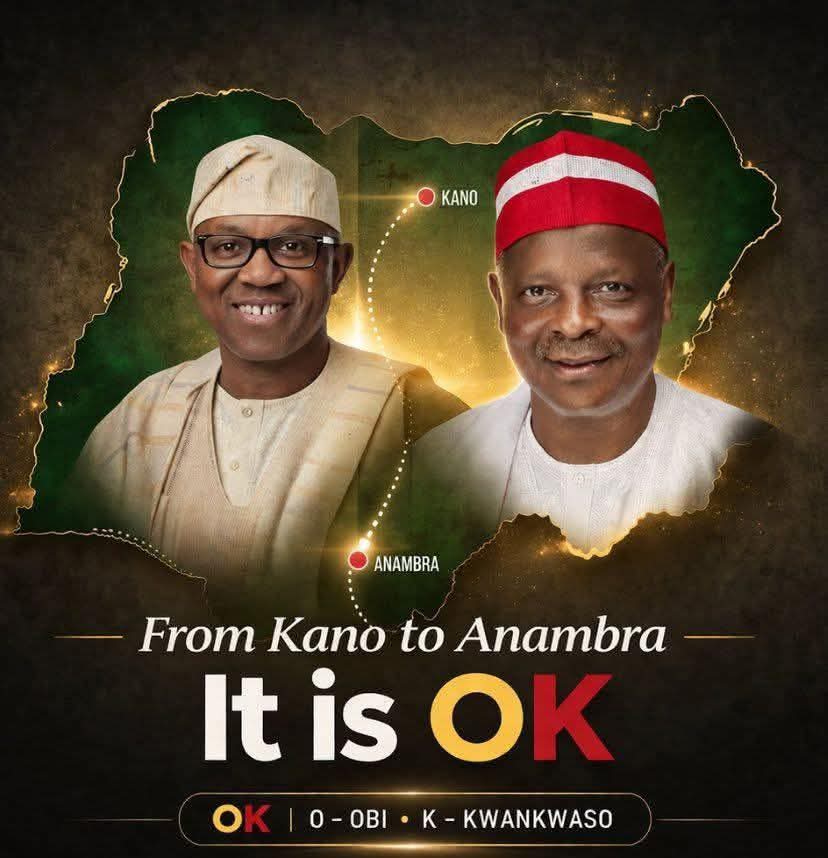
2.1 The Structural Meaning of the OK Movement and the NDC Migration
Nigeria’s political landscape in 2026 is no longer being discussed as isolated defections or routine party switching, but as a completed structural realignment that is already shaping expectations for the 2027 general election.
The migration pattern tells the full story: Atiku Abubakar moved from PDP into ADC, temporarily repositioning ADC as the main opposition convergence point. Peter Obi and Rabiu Kwankwaso then exited ADC into NDC, creating a second wave of consolidation that redirected opposition gravity toward a new political centre.
NDC has now emerged as the consolidated opposition centre following this final migration phase.
What makes this particularly powerful is the complementarity of the two principals.
Peter Obi provides national youth engagement and urban electoral momentum.
Kwankwaso provides northern grassroots structure and disciplined voter mobilisation.
This is not a merger of convenience; it is a fusion of the two most structurally distinct but electorally critical voter blocs in Nigeria: the Obidient youth movement and the Kwankwasiyya northern machine.
At their formal reception into the NDC, the party’s national leader Seriake Dickson described them as “personifications of the crowd” who bring clear value to the platform.
Kwankwaso urged his supporters, especially members of the Kwankwasiyya movement, to align with NDC; a signal that the political machinery is being formally redirected into the new coalition.
2.2 Gravitational Pull: Politicians Follow Momentum, Not Loyalty
In Nigerian politics, elected officials and party structures migrate toward power and viability. The current migration flow; uniformly moving toward NDC; is the most reliable leading indicator of where 2027 electoral outcomes are expected to land.
Politicians do not defect to losing platforms. They defect to anticipated winners.
Analysts describe the OK movement’s alignment with NDC as part of a broader push to unify fragmented opposition forces under a single, more formidable platform capable of challenging the ruling establishment; and the coming months are expected to witness further negotiations, defections, and coalition-building efforts that could ultimately shape Nigeria’s next presidential contest.
The NDC’s emergence as what analysts describe as a “rallying point for aggrieved stakeholders seeking a fresh start” is no accident.
It is the product of disciplined coalition architecture at a moment of maximum APC vulnerability.
The APC’s vulnerability is not just political; it is existential. Strategists look for the “tipping point” where a government’s failures become its identity.
The Strategy of Pre-Election Collapse
To destroy the APC’s hopes by December 2026, the NDC must employ a strategy of Psychological and Structural Encirclement.
- Economic Criminality: By framing the current administration’s policies not just as “mismanagement” but as “economic sabotage,” the NDC can alienate the business elite and the middle class.
- Insecurity as Governance Failure: The inability to protect citizens is the ultimate breach of the social contract. By December 2026, the NDC must consistently highlight that the APC has lost the “monopoly on violence,” making them appear unfit to lead.
- The Inevitability Narrative: Politics is a game of momentum. As prominent governors and legislators defect from APC/ADC to the NDC, it creates a “sinking ship” effect. By 2026, the goal is to make the APC look like an isolated island of elites vs. a united nation.
PART III: THE JERICHO STRATEGY; HOW TO DESTROY APC’S HOPES BEFORE DECEMBER 2026
The Core Thesis
The walls of Jericho fell not because of military superiority but because of sustained encirclement, perfect timing, and unified collective action.
The APC is already weakened.
The NDC coalition is already assembling.
The strategic task between now and December 2026 is to ensure that by the time the formal campaign season begins in early 2027, the APC enters the race a defeated party; psychologically, narratively, and structurally.
History offers several models for battles won before the first shot was fired:
- Jericho (Joshua 6): A fortified city collapsed not through military force but through coordinated encirclement, sustained presence, and a final unified sound. The city’s walls were structurally compromised over seven days; the final trumpet only revealed what was already true.
- The Fall of the Berlin Wall (1989): The wall did not fall because armies attacked it. It fell because of sustained civil pressure, mass emigration that drained the system of legitimacy, and a moment when the East German government; exhausted and contradicted; simply stopped pretending it could hold. No shots were fired.
- The Fall of Apartheid (1990–1994): South Africa’s regime was not defeated on a battlefield. It was defeated through economic sanctions, internal civil disobedience, international isolation, and the gradual collapse of the moral and institutional justifications for its existence. By the time de Klerk released Mandela, the battle was already won.
- Gandhi’s Salt March (1930): Britain’s colonial authority in India was fundamentally broken not by armed resistance but by a 240-mile walk to the sea. The act of making salt; simple, symbolic, legal; exposed the violence and illegitimacy of colonial rule to the entire world. The moral defeat preceded the political one by years.
- The People Power Revolution (Philippines, 1986): Ferdinand Marcos had the military and the money, but he lost the moral right to rule. When the masses stood firm, the military refused to fire. The regime collapsed from within.
Applying the Jericho Strategy to NDC
- The “Seven Circuits”: For the next 18 months, the NDC must “march” around the APC’s strongholds with a message of radical transparency and competence.
- The “Shout” (The December 2026 Threshold): By December 2026, the NDC should coordinate a massive, nationwide display of unity (rallies, digital takeovers, and town halls) that demonstrates the APC has zero grassroots support left.
- The Internal Collapse: When an incumbent party sees the writing on the wall, the “walls” crumble as internal factions begin to negotiate their surrender or defection to the new power center.
The APC’s walls are already cracked.
The strategy is encirclement, not frontal assault.
The Five-Pillar Strategic Plan (Now Through December 2026)
PILLAR ONE: DOCUMENTATION AS WEAPON Every economic failure must be systematically catalogued, quantified, and published with citizen faces attached. The 63 percent poverty figure is not a statistic; it is the face of a widow in Kano who cannot afford kerosene. Every security attack must be named, mapped, and made impossible to dismiss as a one off. By December 2026, the NDC coalition should have published a comprehensive “Governance Audit”; an irrefutable public record of APC’s failures across all 36 states, sector by sector. This is the political equivalent of circling Jericho’s walls: methodical, sustained, visible.
PILLAR TWO: THE DEFECTION ACCELERATOR Every APC governor, senator, or elected official who crosses to NDC between now and December 2026 is a trumpet blast. The narrative of inevitability is itself a weapon. Political actors are rational. When they see the walls shaking, they move before the collapse. The NDC must actively and aggressively recruit across APC structures; particularly in swing states and in northern Nigeria where Kwankwaso’s networks run deepest. Each defection should be staged as a national media event, amplifying the perception of APC collapse.
PILLAR THREE: YOUTH AS THE VANGUARD The Obidient movement demonstrated in 2023 that Nigerian youth can generate electoral tsunamis when properly motivated. The OK movement must convert that energy into structured voter registration, local chapter organization, and digital mobilisation that reaches the diaspora. By December 2026, NDC must have functional structures in every senatorial district. The youth are not just voters; they are the trumpets. Their noise, presence, and energy will signal to the political establishment that the walls are falling.
PILLAR FOUR: NARRATIVE MONOPOLY; MAKE 2027 A REFERENDUM, NOT AN ELECTION The single most powerful reframe the NDC can execute is this: make the 2027 election not a contest between candidates but a referendum on hunger, insecurity, and dignity. Every NDC communication between now and December 2026 must ask a single repeated question: “Are you better off than you were in May 2023?” When 93 percent of Nigerians already believe the country is heading in the wrong direction, the answer is already written. The opposition’s task is to ensure that feeling is politically channeled; into registration, into mobilization, and ultimately into the ballot box.
PILLAR FIVE: LEGAL AND INSTITUTIONAL ARMOR Peter Obi, in his NDC acceptance remarks, specifically called for a party without litigation and appealed to the judiciary to expedite political cases; a recognition that institutional warfare will be the APC’s primary tool of disruption. Between now and December 2026, the NDC must bulletproof its internal structures, preempt legal challenges to its candidate selection processes, and build a legal defense architecture that can withstand coordinated institutional attacks from INEC and APC-aligned courts. A coalition that fractures internally has handed the enemy a victory without a vote being cast.
The “December 2026” Endgame
To ensure the APC’s hopes are destroyed before the election year begins, the NDC must execute three “knockout” moves:
- The Shadow Cabinet: Release a full “Shadow Government” by Nov 2026, featuring credible experts. This makes the NDC look like a government-in-waiting, while the APC looks like a government-in-exit.
- The Defection Tsunami: Time the highest-profile APC defections for the final weeks of 2026 to create a sense of total panic within the ruling party.
- The Moral Indictment: Launch a global campaign highlighting the “human cost” of the current administration’s failures, making it socially and politically “toxic” to be associated with the APC brand.
The APC relies on a “fortress” of incumbency, but every fortress has a flaw.
By combining the ethical appeal of Obi with the structural discipline of Kwankwaso, the NDC isn’t just a party; it’s a national consensus. When the people decide a regime is over, it is over; the election becomes a mere formality, a “shout” that finally brings the walls down.
CONCLUSION: THE WALL IS ALREADY SHAKING
The most important political fact of May 2026 is this: the APC does not control the narrative of its own governance. Its closest allies call its agenda a scam. Its president has declared his own tenure a national emergency. Its poverty and insecurity figures are self-indicting. Its politicians are migrating in one direction. As Atiku Abubakar declared at the start of 2026: “2026 is the year to till the soil. 2027 is the year of harvest.”
The NDC coalition under the OK movement has what no previous opposition formation has achieved in one structure: national urban youth appeal, northern grassroots depth, and a clean, litigation-free platform positioned explicitly as the antidote to APC’s chaos.
The walls of Jericho were tall, ancient, and seemingly impregnable. But they were hollow underneath. The encirclement had done its work before the trumpets sounded.
Nigeria’s opposition does not need to win the election in 2027. It needs to win the psychology of inevitability by December 2026. When that is achieved, the election becomes a formality; and the walls of APC’s political fortress will come down not with a bang, but with the quiet, inexorable logic of a people who have decided that enough is enough.
The trumpets are already sounding. The only question is whether every voice joins the cry.