
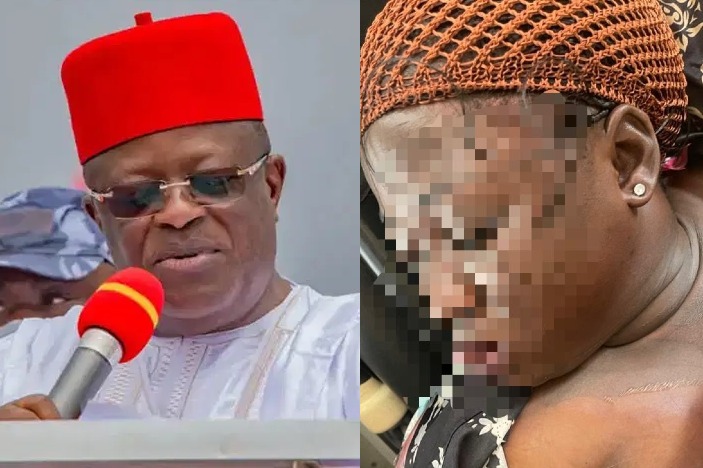
On the morning of June 27, 2026, a young Nigerian physiotherapist named Mary Habila was found dead inside the private residence of David Umahi, Nigeria’s Minister of Works, in Uburu, Ohaozara Local Government Area of Ebonyi State. According to exclusive reporting by SaharaReporters, her body was removed from the minister’s home without clothing, a detail the outlet says it independently verified through photographs. For nearly two weeks after her death, the Ebonyi State Government and the state police command said nothing. The minister himself spoke only after journalists forced the story into the open, and when he finally did, police sources familiar with the investigation promptly disputed his account. From Aso Rock, the seat of President Bola Ahmed Tinubu’s government, there has been the most telling response of all: silence.
That silence is the subject of this article. A woman is dead in the home of one of the most powerful men in the Nigerian cabinet, under circumstances that investigators themselves admit they cannot yet explain, and the President of the Federal Republic has neither suspended his minister, ordered an independent inquiry, nor uttered a single public word of concern. In any functioning democracy, the unexplained death of a citizen inside a serving minister’s private residence would trigger an immediate political reckoning. In President Tinubu’s Nigeria, it has triggered a press statement, a threat of litigation against journalists, and business as usual. That gap between what accountability demands and what this presidency delivers is no longer an embarrassment. It is a human rights problem.
The Facts as Reported
The outline of the case, as pieced together by SaharaReporters and corroborated in parts by Daily Post, P.M. News and other Nigerian outlets, is deeply troubling. According to multiple police sources cited by SaharaReporters, Mary Habila and a second woman identified in reports as Baski travelled from Kaduna State and arrived at the minister’s country home in Uburu on June 26, 2026. The sources allege that the two women were brought to the residence to attend to the minister, and that a police officer serving as Senator Umahi’s personal assistant, who previously served as his aide-de-camp during his tenure as Governor of Ebonyi State, was the person responsible for bringing them there. The following morning, Habila was found dead inside the residence.
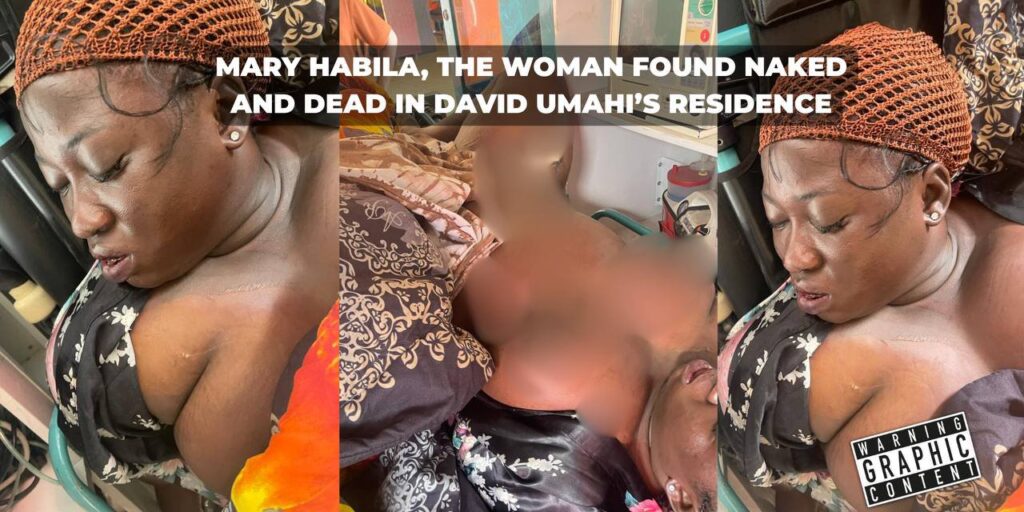
What happened between her arrival and her death is precisely what investigators say they are still working to establish. What is known is disturbing enough. SaharaReporters reported that photographs it obtained and verified show that Habila was found without clothing when her body was removed from the residence. The case was transferred from the Ohaozara Divisional Police Headquarters to the Ebonyi State Criminal Investigation Department in Abakaliki, a step that signals the police themselves regard this as a matter of consequence. Yet for days after the death, the reporting indicates the incident was shrouded in secrecy, with both the state government and the state police command maintaining public silence until journalists broke the story on July 10.
Minister Umahi’s response came through a statement issued by his media aide. He confirmed that Habila died at his residence, described her death as unfortunate, and said he received the news with profound shock and sadness. He claimed that she was a physiotherapist employed by the David Umahi Federal University of Health Sciences and seconded to his home through the Federal Ministry of Works, that emergency measures were activated immediately, that the police were promptly notified, and that he personally received her parents and advised them to consent to an autopsy, which he says the family initially declined. He has since vowed legal action against those circulating what he calls false reports.
A Story That Does Not Hold Together
Every citizen, ministers included, is entitled to the presumption of innocence, and nothing in the public record establishes that Minister Umahi committed any crime. But the presumption of innocence is a legal standard for courtrooms. It has never been the standard for holding public office, and it does not excuse the obvious holes in the official narrative. Police sources familiar with the investigation have directly disputed the minister’s claim that the women were physiotherapists formally seconded to his household, telling SaharaReporters instead that they were brought from Kaduna to attend to the minister. These are not compatible accounts. One of them is wrong, and the public has a right to know which.
The secondment claim raises its own questions. By what official process are staff of a federal university teaching hospital seconded not to a ministry, not to a public facility, but to the private country home of a minister? Who authorised it, on what terms, and for what public purpose? Why did two health workers travel from Kaduna State, hundreds of kilometres away, to a private residence in Ebonyi, when the minister’s own account says the institution that employed them sits in the very town where he lives? Why was the death kept from the public for almost two weeks? And why is the minister’s most energetic public response so far a threat to sue journalists rather than a demand for the swiftest and most transparent investigation Nigerian law allows? None of these questions convicts anyone. All of them demand answers that only an independent process, insulated from the minister’s considerable power in Ebonyi State, can credibly provide.
The Presidency’s Studied Silence
This is where President Tinubu enters the story, and where his government fails the test. As of this writing, the President has issued no statement on Mary Habila’s death. He has not directed the Inspector-General of Police to take over an investigation currently sitting with a state command in a state where the minister concerned served two terms as governor and where the university involved bears his name. He has not asked his minister to step aside while investigators do their work. He has not acknowledged, even in the mildest terms, that a citizen died in circumstances that his own country’s police describe as still unexplained. The Presidency that finds time to congratulate footballers and commiserate with foreign governments has found no words for the family of Mary Habila.
Defenders of the administration will say that the President should not prejudge an ongoing investigation. That argument inverts the logic of public accountability. Suspending a minister pending investigation is not a punishment and not a verdict. It is the minimum act of institutional hygiene that protects the integrity of the inquiry, shields witnesses from the shadow of ministerial power, and assures the public that the state values a citizen’s life more than a politician’s comfort. Nigeria’s own recent history shows the presidency understands this perfectly well when it chooses to. In January 2024, President Tinubu suspended the Minister of Humanitarian Affairs, Betta Edu, within days of media reports that she had directed 585 million naira into a civil servant’s private account. The precedent exists. The President simply declines to apply it when the minister in question is a political heavyweight whose loyalty matters to his re-election arithmetic.
A Pattern, Not an Aberration
If the Habila case were an isolated lapse, it might be attributed to caution. It is not isolated. The Betta Edu affair itself illustrates how accountability works in this administration: a suspension extracted by public outrage, an EFCC investigation whose report has never been made public, no charges filed more than two years later, and a quiet replacement announced ten months on. The suspension was the beginning and the end of the accountability. Around the same period, the head of the National Social Investment Programme Agency was arrested over the alleged movement of 44 billion naira from agency accounts. Nigerians are still waiting for a public accounting of that money. Scandal after scandal follows the same arc under this presidency: revelation by journalists, denial or minimisation by officials, a holding statement if pressure grows, then institutional amnesia.
The consequences of this pattern are corrosive in ways that go beyond any single case. When ministers learn that the political cost of scandal is a few uncomfortable news cycles, the incentive to behave lawfully weakens across the entire cabinet. When investigations of the powerful are left with institutions those same powerful figures once controlled, witnesses draw the obvious conclusion about the wisdom of speaking. And when the President’s response to the death of a young woman in a minister’s house is indistinguishable from his response to nothing at all, citizens absorb the most dangerous lesson of any: that some lives simply do not count enough to disturb the calendar of power.
There is a particular cruelty in the details here. Mary Habila was not an abstraction. She was a health professional, someone’s daughter, a woman who travelled across the country and was dead within a day of arriving at a powerful man’s home. The reported condition in which her body was found, unclothed, has understandably fuelled public suspicion and anguish. Nigerians on social media and civil society voices have demanded answers, and the response of officialdom has been to lawyer up and wait for the news cycle to move on. President Tinubu’s silence does not merely tolerate that strategy. It ratifies it.
What Nigeria’s Own Commitments Require
None of this is only a matter of politics or decency. It is a matter of binding legal obligation. Section 33 of the Nigerian Constitution guarantees the right to life. Article 4 of the African Charter on Human and Peoples’ Rights, which Nigeria has domesticated into its national law, does the same, as does Article 6 of the International Covenant on Civil and Political Rights, to which Nigeria is a party. Human rights jurisprudence has long established that these guarantees are not exhausted by prohibiting unlawful killing. They impose a positive procedural duty on the state to conduct a prompt, independent, impartial, effective and transparent investigation into any potentially unlawful death, a standard elaborated in the Minnesota Protocol on the Investigation of Potentially Unlawful Death, the United Nations benchmark for such inquiries.
Measured against that standard, the handling of Mary Habila’s death has been deficient from the first hour. Promptness failed when the death was kept from the public for nearly two weeks. Independence is in doubt while the investigation rests with a state command operating in the political backyard of the very minister whose home is the scene, and while a police officer on the minister’s personal staff is, per the reporting, a central witness. Transparency failed when both the state government and the police declined all public comment until journalists forced the issue. The autopsy, the single most important piece of evidence in any death investigation, was reportedly delayed amid disputes over family consent. Each of these failures is individually explicable. Together, and met with total presidential indifference, they amount to a state that is not discharging its duty to investigate.
The gendered dimension deserves its own reckoning. Nigeria has a documented crisis of violence against women and a chronic pattern of impunity when the men implicated are wealthy or politically connected. Whatever the eventual findings in this case, the spectacle of a young woman dying unexplained in a minister’s residence while the government of the day looks away sends an unmistakable message to every Nigerian woman about whose safety the state will exert itself to protect. The Violence Against Persons (Prohibition) Act and Nigeria’s obligations under the Maputo Protocol were written precisely so that such deaths would never be quietly absorbed into the routine of power.
What Accountability Would Actually Look Like
The steps required of President Tinubu are neither radical nor unprecedented, and the fact that they must be spelled out at all is itself an indictment. He should direct Minister Umahi to step aside from office while the investigation runs, exactly as was done with Betta Edu, so that no witness, pathologist or police officer must weigh their testimony against the power of a sitting minister. He should instruct the Inspector-General of Police to transfer the case to a federal homicide team with no institutional ties to Ebonyi State, and invite the National Human Rights Commission to monitor the inquiry. He should ensure an independent forensic autopsy with the family’s participation and international observation if the family desires it, guarantee protection for Baski and every other witness, and commit publicly to releasing the investigation’s findings. And he should retire, once and for all, the practice of ministers threatening defamation suits against the journalists whose reporting is the only reason the public knows Mary Habila’s name.
President Tinubu campaigned on the phrase Renewed Hope. Hope, renewed or otherwise, cannot coexist with a government in which a citizen can die naked and unexplained in a minister’s house and the President cannot summon a sentence of concern. The measure of a leader is not how he treats his allies in their triumphs but whether he is willing to subject them to the same law that binds the citizens they serve. Mary Habila’s family deserves the truth. Nigeria deserves a president who demands it. So far, on both counts, Bola Tinubu has chosen silence, and silence, in the face of a death like this, is a choice for which history and the Nigerian people should hold him accountable.