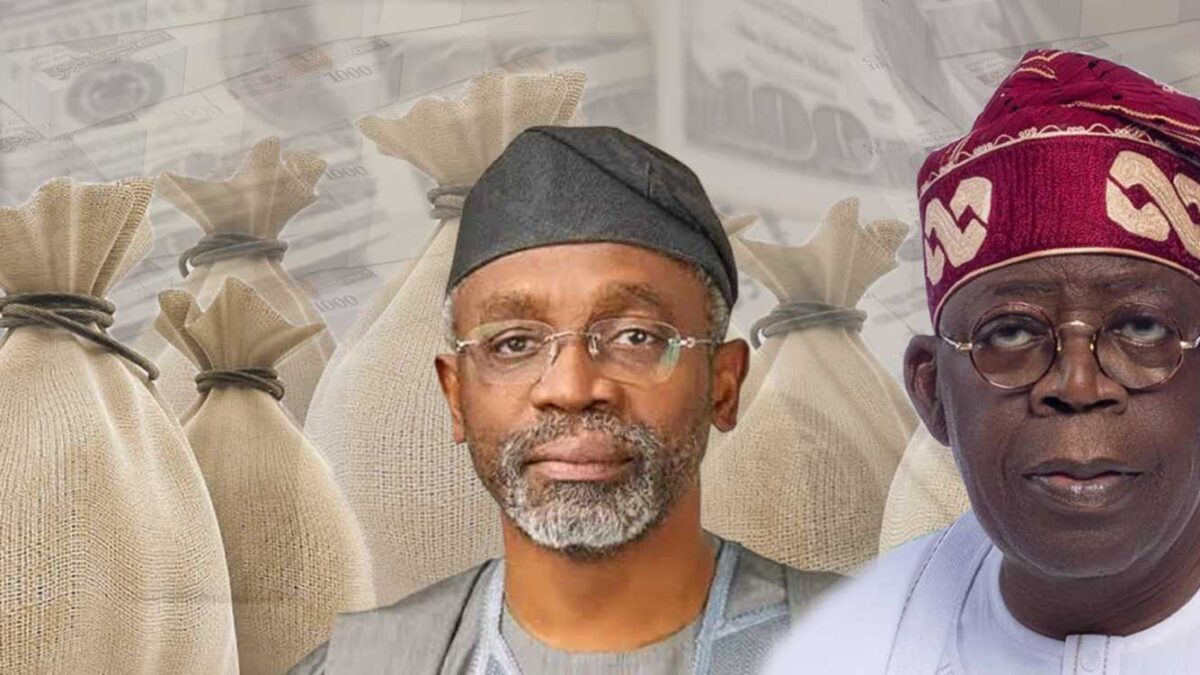
Every presidency reveals itself in its paperwork. On July 4, 2023, barely five weeks after President Bola Ahmed Tinubu took the oath of office promising Nigerians an era of Renewed Hope, his chief of staff, Femi Gbajabiamila, signed a memo directing that 1.5 per cent of the cost of collection of the Nigeria Upstream Petroleum Regulatory Commission, a sum equal to 54 billion naira, be ring-fenced for the vaguely worded purpose of upgrading crude oil and gas metering and transparency systems. According to an exclusive investigation published this week by Peoples Gazette, which reviewed the memo, the legal authority Mr Gbajabiamila cited for this extraordinary claim on public oil revenue was Section 24(2)(c) of the Petroleum Industry Act. The Gazette checked the provision. It says nothing of the kind. It is a bare clause identifying the cost of collection as a source of the commission’s fund, and the newspaper reports that the actual power over the commission’s expenditure belongs, under Section 24(1) of the same Act, not to the president or his chief of staff but to the National Assembly through appropriation.
Confronted with these findings, the presidency did not dispute the memo, did not explain the false citation, and did not promise an inquiry. Instead, presidential spokesman Bayo Onanuga told the Gazette that Mr Gbajabiamila did not commandeer any money and that the directive was within the right of the president as commander-in-chief, adding that there was no smoking gun. Consider what that defence concedes. The presidency’s answer to documented evidence that billions of naira in oil revenue were diverted on the strength of a misquoted law is that the president personally ordered it. In most democracies that admission would be the scandal. In President Tinubu’s Nigeria, it is the alibi.
Three Years, One Unbroken Pattern
The NUPRC memo would be damning enough as an isolated document. It is not isolated. It is one entry in a ledger of alleged criminality, self-dealing and impunity that has run without interruption from the first weeks of this administration to the present day, and it is the cumulative weight of that ledger, not any single scandal, that now makes the case for President Tinubu’s resignation, or at minimum his withdrawal from the 2027 presidential race.
Begin with the man who signed the memo. Femi Gbajabiamila is not a peripheral figure; he is the gatekeeper of the Nigerian presidency, the official through whom every minister, governor and memo must pass. Peoples Gazette has reported that he was disbarred in the United States, where the State Bar of Georgia suspended him in 2015 and terminated his licence in 2020 over the alleged theft of a client’s money and his refusal for months to answer the Bar’s summonses. The Gazette has also reported allegations that, as Speaker of the House of Representatives in 2022, he accepted two million dollars in cash bribes to secure passage of the Petroleum Industry Bill over the protests of host communities. He denies wrongdoing, and none of these allegations has been tested in a Nigerian court. But the question for President Tinubu has never been whether his chief of staff is guilty. It is why a man trailed by this record was handed the keys to the presidency at all, and why he retains them as the allegations multiply.
And multiply they have. For the past month, Nigeria has been transfixed by the affair of the Presidential Foreign Intervention Promotion Council, an agency the presidency insists does not exist yet which somehow appeared in the 2026 Appropriation Act with a reported allocation of 1.3 billion naira. Adeniyi Adeyemi, the man who claims to have been appointed its director-general, has publicly accused Mr Gbajabiamila of collecting 400 million naira through a proxy, demanding a further 200 million naira to secure his appointment, and seeking 48 per cent of the council’s reported 27.7 billion naira take-off grant. Mr Gbajabiamila has denied everything and threatened a 10 billion naira defamation suit. Yet Mr Adeyemi’s central question remains unanswered and, on the current record, unanswerable: if the agency does not exist, how did it find its way into the national budget that the president signed? As Mr Adeyemi put it, if a non-existent agency can be funded in the Appropriation Act, then the integrity of the entire budget is in doubt. Even Atiku Abubakar, the former vice president, observed through his spokesman that scandals have become a feature of governance under this administration, citing a troubling sequence that includes the humanitarian ministry affair and crude oil theft allegations that faded without any published investigative report.
The pattern extends across the cabinet. Betta Edu, the humanitarian affairs minister, was suspended in January 2024 after directing 585 million naira meant for vulnerable Nigerians into a civil servant’s private account; more than two years later, the EFCC’s report has never been published and no charges have been filed. Halima Shehu, the social investment agency chief, was arrested over the alleged movement of 44 billion naira in four days; the public accounting never came. Bello Matawalle sat as Minister of State for Defence while civil society groups petitioned the EFCC over allegations, which he denies, that as governor of Zamfara he mismanaged tens of billions of naira, with one group accusing the commission itself of shielding him. And only this week, as I documented in a companion article, the presidency has maintained total silence over the death of Mary Habila, a young physiotherapist found dead, reportedly unclothed, inside the private residence of the Minister of Works, David Umahi, in circumstances police investigators say they cannot yet explain. In three years, not one of these episodes has produced a published investigation report, a prosecution of a sitting official, or a word of presidential candour.
It is worth pausing on how each of these stories reached the public, because the common thread is instructive. Not one was disclosed by the government. The NUPRC memo, the disbarment records, the PFIPC budget lines and the circumstances of Mary Habila’s death were all excavated by independent journalists at Peoples Gazette, SaharaReporters and a handful of other newsrooms, working against official stonewalling and, in several cases, under explicit threats of multi-billion-naira lawsuits from the officials they exposed. A government whose first instinct on every revelation is to punish the messenger has told you everything about its relationship with the truth.
The Fish Rots From the Head
Defenders of the president like to frame these scandals as the misdeeds of subordinates, regrettable but distant from the man himself. The NUPRC memo destroys that framing. By the presidency’s own account, the diversion of the 54 billion naira was done on the president’s directive. The chief of staff who signed it acts in the president’s name. The budget containing the phantom agency was presented and signed by the president. The ministers who remain in office despite unresolved allegations remain there because the president keeps them. The anti-corruption agencies that open investigations with fanfare and close them in silence answer, in practice, to the president’s political needs. At some point, the pattern stops being a series of accidents around Bola Tinubu and becomes a description of how Bola Tinubu governs.
Nor does the president arrive at this moment with a reservoir of personal credibility to draw upon. In 2024, the Organized Crime and Corruption Reporting Project named him a finalist for its Corrupt Person of the Year designation, an assessment the presidency furiously rejected but which reflected how the world’s investigative journalists read his record. That record includes the well-documented 1993 forfeiture of 460,000 dollars to the United States government in a civil proceeding connected to a heroin trafficking investigation, and OCCRP has reported that US agencies continue to block release of records concerning those historical allegations. A president with that biography, governing a state awash in unresolved scandal, owed Nigerians a standard of transparency so exacting that no reasonable citizen could doubt him. He has delivered the opposite.
The human cost of this impunity is not abstract. Every naira cornered through a misquoted statute is a naira taken from a country in which tens of millions of people fell deeper into poverty after the president’s subsidy removal and currency reforms, policies whose pain Nigerians were told to endure as the price of fiscal honesty. The moral bargain of Renewed Hope was that sacrifice at the bottom would be matched by discipline at the top. The bargain has been broken in only one direction. Citizens queue for fuel and skip meals; the men around the president allegedly queue for percentages.
There is also a security dimension that makes this impunity uniquely dangerous. A treasury that leaks at the top starves the institutions Nigerians depend upon for their lives, not merely their livelihoods. Every unexplained billion is a billion unavailable for the soldiers fighting insurgents in the North East, the police commands stretched thin across kidnapping corridors, the hospitals and schools hollowed out by decades of theft. When citizens in Benue and Plateau bury their dead after massacres that the state failed to prevent, and then read that 54 billion naira moved on the strength of a false legal citation, the social contract does not merely fray. It dissolves.
The Case for Resignation
This is why the remedy must now be political, not merely procedural. Under Section 15(5) of the Nigerian Constitution, the state is obliged to abolish all corrupt practices and abuse of power. The president swore an oath to preserve, protect and defend that Constitution. When the presidency itself asserts the power to direct agency revenues in defiance of the appropriation clause of a federal statute, when it dismisses a false legal citation as a matter of no consequence, and when it responds to every scandal with silence, denial or threats of litigation against journalists, the constitutional machinery of accountability has been captured by the very office it is meant to police. A president who cannot investigate his own inner circle without indicting himself cannot credibly lead an anti-corruption state. Resignation is the constitutional mechanism by which a leader acknowledges that his continuation in office has itself become the obstacle to accountability.
If resignation is too much to ask of a man who fought his whole life for this office, then the lesser demand follows inescapably: Bola Tinubu should not seek re-election in 2027. An election is a request for renewed trust. On what basis would that request be made? The president cannot run on the integrity of a budget that funded a non-existent agency, on the diligence of investigations whose reports Nigerians have never seen, or on the discipline of a cabinet in which ministers survive every scandal that engulfs them. Stepping aside would allow his party to present a candidate unencumbered by this record, allow the investigations his office has ordered, including the 30-day ICPC probe of the PFIPC affair, to proceed without the suffocating question of the president’s own exposure, and allow Nigerians to choose their next government free from the shadow of an incumbent whose machine has every incentive to bury the truth.
Fairness requires acknowledging the other side of the ledger. The presidency insists the NUPRC directive was lawful and that no money was commandeered. Mr Gbajabiamila denies every allegation against him and has gone to court. The president did order the ICPC to investigate the PFIPC scandal within 30 days and has promised prosecution of anyone found culpable. His government points to the EFCC’s prosecution of Godwin Emefiele and Yahaya Bello, and to the arraignment of former governors and ministers, as proof of political will. Whether the July 2023 directive amounted to a constitutional overreach, as the Gazette’s analysis suggests, is a question only a competent court can finally settle, and no court has yet done so. All of that is true, and none of it answers the central charge. Prosecutions of yesterday’s officials do not absolve today’s inner circle. Investigations ordered under duress, by an office implicated in the conduct being investigated, are not accountability; they are its simulation.
Nigeria has been governed before by men who confused the treasury with a private estate, and it has paid for them in lost generations. What is different now is that the looting proceeds under the vocabulary of reform, stamped with legal citations that turn out to be false, defended by spokesmen who call presidential fiat a sufficient answer to statute. Mary Habila’s family waits for the truth. The host communities of the Niger Delta wait for their share. A hundred million poor Nigerians wait for the sacrifice at the top that was promised to match their own. President Tinubu can wait out none of them forever. He should resign; failing that, he must not ask Nigerians to renew a mandate he has so comprehensively betrayed. History is unsentimental about leaders who mistake survival for vindication, and it is already writing.