
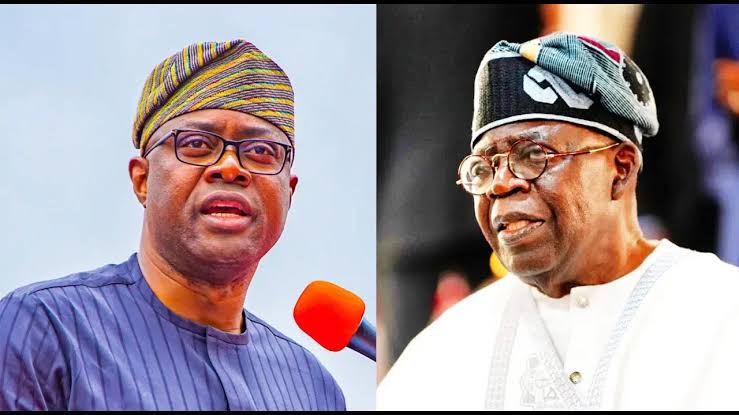
At four o’clock in the afternoon of May 14, 2026, Governor Seyi Makinde of Oyo State stood before a rally in Ibadan and declared that he would contest the presidency of Nigeria in 2027, promising to reset a broken country. By nine o’clock the following morning, gunmen had descended on schools in Oriire Local Government Area and carried away pupils and their teachers into the bush. Sixteen hours. That is the distance between the moment Seyi Makinde became a direct threat to Bola Tinubu’s south-western base and the moment Oyo State, which by the governor’s own account had not suffered a single incident of this kind in his seven years in office, suddenly produced Nigeria’s latest stolen children.
Makinde himself has said it aloud, with the caution of a man who knows exactly how dangerous the words are: I declared at 4pm, and by 9am the following morning the children were abducted. He has called the circumstances sufficiently grave and unusual to warrant independent scrutiny beyond our domestic institutions, and has formally asked the United Nations system to examine not only the abduction but the circumstances of the rescue, including, in his words, whether there were failures or complicity within the country’s security system. Complicity. A serving Nigerian governor, the chief security officer of his state, is telling the world that he cannot rule out the possibility that the machinery of his own federal government was implicated in the kidnapping of schoolchildren on his soil. Sit with that sentence, because nothing in Nigeria’s descent has been more chilling.
And how did President Tinubu’s government respond to this extraordinary plea for truth? Not with evidence. Not with a white paper, a suspect, a trial date, or a single verifiable detail. The presidency’s answer, delivered through its attack machinery, was to tell the governor he has a dark mind. When a sitting president’s office responds to a call for a UN investigation into the abduction of children with a personal insult, it has told you two things: that it has no answers, and that it fears the question.
Fifty-Six Days of Silence, One Evening of Applause
Consider what Nigerians were actually given. For fifty-six days, children and teachers from Oriire sat in captivity. In all those weeks, the public record shows no presidential visit to Oyo, no address to the nation about the stolen pupils, none of the ostentatious commander-in-chief urgency that the same presidency can manufacture overnight for a political defection ceremony. Makinde spent those weeks pleading the limits of a security architecture in which a governor called chief security officer commands not one soldier and not one policeman, and renewing his case for state police while the federal monopoly on force produced nothing.
Then, hours after the governor began speaking publicly about the timing of the abduction and the need for scrutiny, the presidency suddenly announced that all the victims had been rescued, commending its security agencies for an operation without collateral damage. And that was all. No footage. No briefing on where the children were held for eight weeks, in whose territory, under whose protection. No named suspects, no arrests paraded, no ransom accounted for, no explanation of how an operation of such supposed precision left no evidentiary trail a citizen is permitted to see. In a war where the military films its own airstrikes for the evening news, the most politically sensitive rescue in years happened, we are told, immaculately, invisibly, and precisely when the governor’s questions were becoming unbearable. Nigerians have watched this government stage-manage everything from subsidy pain to budget lines; they can be forgiven for asking whether a rescue whose every detail is classified is a rescue or a settlement. Even the president’s allies could offer nothing better than Jimoh Ibrahim’s retort that the UN does not intervene in such matters, which is an argument about jurisdiction, not innocence.
To be scrupulously fair, the record also shows that Makinde thanked the president and the security agencies for the release, and that he received the freed pupils and teachers in Ibadan, promising them support. But gratitude for the return of stolen children is not absolution for the circumstances of their theft, and the governor’s own next act, a formal call for international investigation, tells you what his thanks were worth as an exoneration. He is grateful the children are alive. He does not believe he has been told the truth. Neither should we.
Note, too, the temperature of the relationship while the children were gone. When tragedy strikes a state in any functioning federation, the choreography is familiar: the president telephones the governor, the president appears at the scene, the two men stand grimly together because the children matter more than the party. Nigerians saw none of it. Across eight weeks of captivity, neither Aso Rock nor the governor’s office described a single presidential call of consolation or coordination to Seyi Makinde; the record between Abuja and Ibadan is a blank where a president’s basic humanity ought to be. The contrast is instructive. This is a president who works the phones tirelessly when a governor is being poached into his party, who finds aircraft and retinues for congratulatory visits and campaign flag-offs. For the governor whose schoolchildren were in a forest, and who happened to have declared against him sixteen hours before they were taken, there was no such energy, only the eventual press statement claiming credit for the rescue. Cold-shouldering a rival is ordinary politics. Cold-shouldering a rival while his constituents’ children sit in captivity under a security apparatus only you control is something Nigerians have every right to call by an uglier name.
A Government That Calls Terrorists Family
If the suggestion of official complicity in terrorism sounds paranoid, listen to the men Bola Tinubu personally chose to run Nigeria’s war on terror describe the enemy. His Chief of Defence Staff, General Olufemi Oluyede, defending the policy of rehabilitating jihadists rather than defeating them, reached for scripture: even in the Bible, we heard about the prodigal son. The men who burn churches, hack farmers to death and empty schoolrooms at gunpoint are, to the president’s top general, prodigal sons awaiting their window to repent. The National Security Adviser, Nuhu Ribadu, calls bandits our brothers that we must live with. The Chief of Army Staff, Lieutenant-General Waidi Shaibu, was recorded on video addressing surrendered fighters as my sons. This spring, the administration graduated 744 so-called repentant terrorists from rehabilitation amid national outrage, while their unrepentant colleagues continued harvesting children from classrooms. And hovering over the whole enterprise, as he has for years, is Sheikh Ahmad Gumi, the cleric who strolls unharmed into bandit camps that the entire Nigerian Air Force apparently cannot locate, returns with their demands, and advocates their amnesty on national television. The opposition ADC said what every Nigerian was thinking: a security leadership that speaks of murderers in the language of kinship has told you whose side of the family it sits on.
This is the context in which sixteen hours must be read. A state that knows its terrorists well enough to negotiate with them, rehabilitate them, and address them as sons and brothers is a state that cannot claim helpless ignorance when those same networks execute a surgically timed atrocity in the one south-western state governed by the president’s most dangerous new rival. Either the intelligence services did not see a mass abduction being prepared in Oyo within hours of Makinde’s declaration, in which case the billions consumed by the NSA’s office have purchased blindness, or somebody saw it and let it happen, which is the possibility Makinde’s word complicity politely wraps in legal cotton. Incompetence or complicity. It is the same fork this column has pressed against this presidency before, and Aso Rock has yet to choose a tine.
Cui Bono, Mr President?
Motive is the question no insult from the presidency can dissolve. Seyi Makinde is not a marginal irritant. He is a twice-elected southern governor with a national profile, and his entry into the 2027 race threatens to do to Tinubu what no northern challenger can: split the Yoruba south-west, the electoral fortress on which the president’s entire re-election arithmetic stands. The two men’s frictions are a matter of long public record. A kidnapping crisis in Oyo, timed to the hour of Makinde’s declaration, accomplishes precisely what a rival incumbent would want: it stains the governor’s security record on his proudest ground, buries his announcement under weeks of anguish, forces him to spend his launch season begging the federal government for help it alone controls, and reminds every voter that no governor can protect his people without Abuja’s consent. If the fire in Oyo was set, it was set by someone who profits from the smoke, and only one campaign in Nigeria profits.
Nigerians have seen this weapon before. In the Jonathan years, as Boko Haram’s abductions and bombings metastasised on the road to 2015, the president’s own circle alleged loudly that the insurgency was being fed and steered by his political enemies to render the country ungovernable and drag him from office; the Chibok girls became the emblem of a security failure that opposition strategists, some of them now seated in this very administration, rode to power. Whether or not those old allegations were ever proven, the men who won an election on the back of a school abduction understand better than anyone alive what a school abduction does to an incumbent governor’s ambitions. That history does not convict Bola Tinubu. It does explain why no serious person in Nigeria finds the suspicion unthinkable, and why the presidency’s refusal of transparency reads less like dignity than like memory.
Answer the Governor, or Answer History
The presidency denies wrongdoing, the rescue did return every victim alive, and Makinde’s call for a UN probe is a demand for facts, not a verdict. All true. But a government innocent of the worst would sprint toward the investigation that clears it. This one hurls insults at the man requesting it. A government innocent of the worst would publish the operational account of the rescue, name the perpetrators, and put them on trial before the cameras it so loves. This one offers a communique and a commendation. Innocence is loud, documented and eager. What Nigeria is getting from Aso Rock is quiet, and the quiet is the scandal.
So the demands write themselves. Support, do not smear, the independent international review Makinde has requested, and grant its investigators access to the intelligence files, the negotiation records and the rescued victims’ unfiltered testimony. Publish a full, verifiable account of the abduction and the rescue, including any ransom or concessions. Retire a security leadership that speaks of Nigeria’s murderers as family, beginning with the officials whose words this article has quoted. And let the president himself, who could not find his voice for fifty-six days of Oyo’s agony but found his spokesmen’s venom within hours of Makinde’s UN request, finally address Nigerians on what his government knew and when.
And if he will not, the conclusion this column reached over the NUPRC billions and the scandals before them only hardens. A president under whom the treasury leaks by memo, ministers outlast every disgrace, and schoolchildren become chess pieces timed to a rival’s press conference has forfeited the presumption that power in his hands is safe. Bola Tinubu should resign. Failing that, he must not stand for re-election in 2027, because an election in which the incumbent’s machine is even plausibly suspected of weaponising terror against a challenger is not an election; it is a hostage negotiation with ballots. The children of Oriire came home after fifty-six days. The truth about who took them, and why, is still in captivity, and every day Aso Rock keeps it there, Nigerians are entitled to assume the ransom is being paid in their name.