In a nation where terrorists, bandits, and non-state actors butcher entire communities with near-impunity, where the body count mounts daily across the North, Middle Belt, and beyond, a journalist’s highest duty is clear: interrogate power, demand results on security, and refuse to fan the very divisions that make collective survival impossible.
Seun Okinbaloye chose the opposite path.
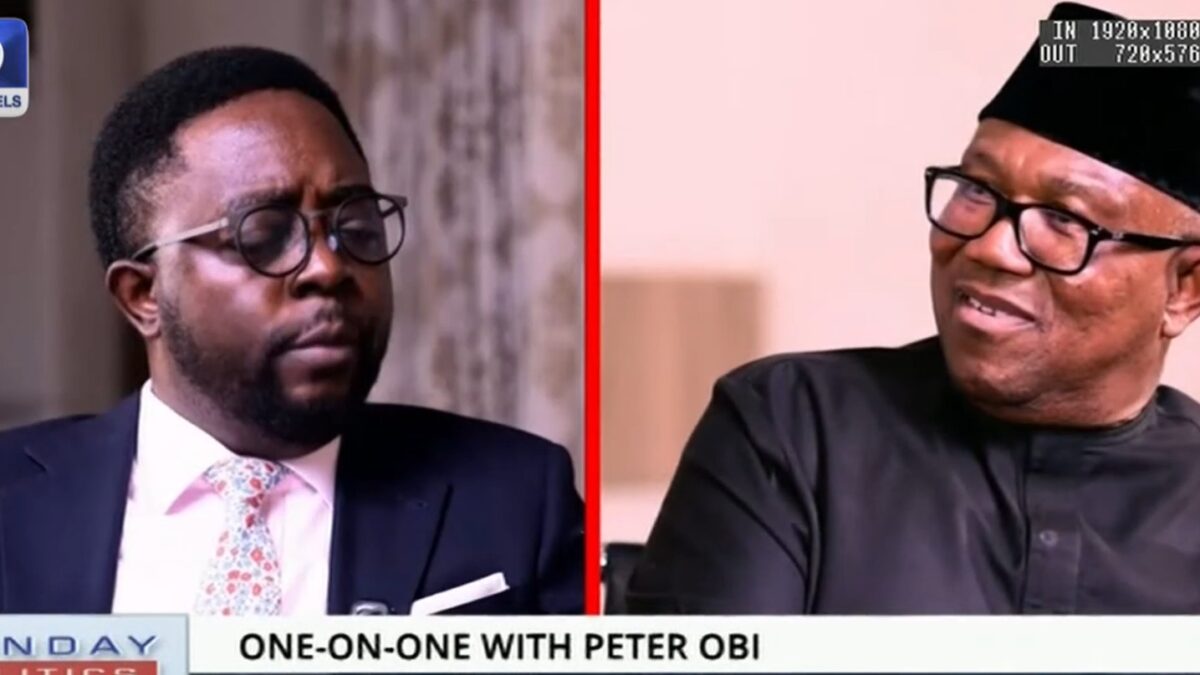
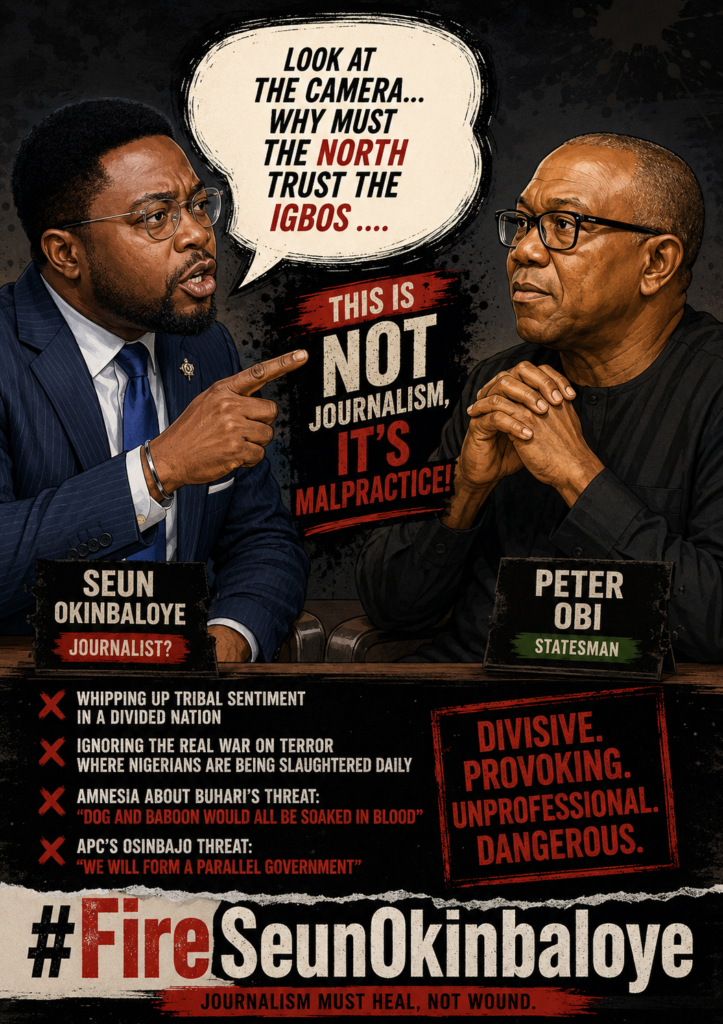
During his interview with Peter Obi, Okinbaloye pressed the former Anambra governor to look into the camera and specifically convince Northern viewers why they should entrust their security and political destiny to him, framed explicitly through the residual trauma of the civil war, the 1966 coup, and the question of whether an Igbo man can be trusted. Obi answered by stressing his knowledge of Northern poverty and challenges and asserting that he was best positioned to deliver the security, unity, and prosperity the region desires. The exchange was not neutral scrutiny. It was a calculated invitation to view a presidential contender first as an ethnic suspect rather than a policy actor.
This is journalistic malpractice of a particularly corrosive kind. Nigeria remains scarred by the Biafran war and its aftermath. To elevate that historical wound into a live litmus test for Northern audiences, while the country faces an active, multi-front war on terror, is not courage. It is reckless ethnic framing. It reduces complex questions of competence, record, and national vision to a tribal loyalty quiz. In doing so, it deepens the very distrust that weakens the social fabric required to confront insecurity. A responsible interviewer in a severely polarized country does not stage such moments for dramatic effect. He subordinates identity theater to the urgent, non-tribal reality of mass abduction, village massacres, and state failure.
The selectivity is telling. In 2012, Muhammadu Buhari warned that if the alleged irregularities of 2011 were repeated in 2015, “by the grace of God, the dog and the baboon would all be soaked in blood.” Ahead of those same elections, senior APC figures, including Yemi Osinbajo, publicly contemplated or defended the formation of a parallel government if they believed victory had been stolen. Those statements carried explosive potential in a tense polity. They did not trigger the same sustained ethnic interrogation that Okinbaloye applied to Obi. The double standard is not subtle: certain politicians are allowed raw, high-stakes rhetoric; others are required to perform ethnic reassurance on camera.
Okinbaloye’s line of questioning did not advance public understanding of how any candidate would dismantle the terror networks, reform intelligence failures, or rebuild state capacity. It instead invited Northern viewers to process Obi primarily through the filter of “Igbo-ness” and civil-war memory. That is not journalism in the public interest. It is the amplification of suspicion at a moment when Nigeria can least afford it. Professional broadcast journalism in a fractured society requires the discipline to keep the focus on shared existential threats rather than reopening old ethnic accounts for ratings or narrative convenience.
The consequences are not abstract. Every time media elevates tribal distrust over the concrete failures that leave communities undefended, it makes national consensus harder and the work of security forces more difficult. Okinbaloye had the platform to press Obi issues surrounding the dire and catastrophic conditions in Nigeria, instead, he chose the path of ethnic pressure. That choice fails the basic test of responsible public-interest journalism in a country already bleeding from division and violence.
History has shown that nations are not destroyed overnight. They are weakened gradually, by the normalization of fear, suspicion, and “us versus them” politics.
Journalism should be the antidote to that disease, not another carrier of it.
Seun Okinbaloye framed governance through ethno-geographic lenses rather than issue-based scrutiny.
Seun Okinbaloye’s handling of that segment was not probing. It was inflammatory. It was not accountability. It was malpractice.
Nigeria’s media owes the public better than the calculated stoking of sentiments that history has already shown can burn out of control.
Seun Okinbaloye must be fired by Channels TV (#FireSeunOkinbaloye) as a demonstration of advancing meaning discourse in Nigeria’s fragile democracy.